



| 2026 |
2025年以前の成果は旧ページを参照してください。
Please refer to the previous website for past research achievements.
2026
-
382. Jialu Song, Keisuke Moriasa, Yosuke Ito, Mojtaba Karimi Habil, Patrick T. Probst, Hiroshi Sugimoto, Minoru Fujii, "Glossy yet Noniridescent Conformal Structural Color Coating of Three‐Dimensional Objects With All‐Dielectric Nanoparticle Monolayers", Small Structures, Vol. , Issue , pp.(2026). (First published:September 3, 2026).
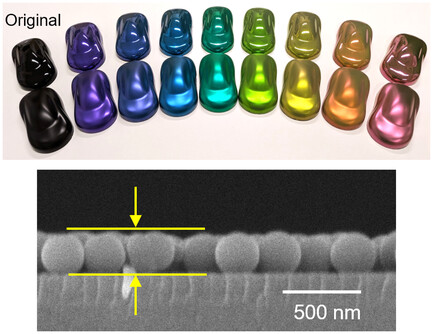
Color coatings with simultaneously high saturation, brightness, and surface gloss are highly demanded for advanced visual applications yet remain challenging with conventional pigment or structural‐color technologies. Here, we propose a core–shell architecture composed of Mie‐resonant silicon (Si) nanosphere (NS) cores and silicon dioxide (SiO2) shells for nanocoatings that enhance both structural color reflectance and surface gloss. This is achieved by precisely controlling the thickness of SiO2 shells, which facilitates the regular alignment of the core–shell particles and optimizes the balance between near‐field couplings and collective interparticle coupling. In the optimized structures, the total reflectance of a monolayer exceeds 75% with a dominant specular component that results in a glossy appearance. Importantly, the coatings are noniridescent despite their glossiness, as the color originates from Mie resonances of individual NSs. We demonstrate glossy‐color coating of three‐dimensional objects (up to ~10 cm in size). Furthermore, we show that the visual appearance can be tuned from glossy to matte through surface pretreatment while employing the same monolayer coating process. This work establishes a new strategy for iridescence‐free structural color coatings with tunable gloss for three‐dimensional objects using dielectric NS monolayers.
-
381. Takeru Kambayashi, Jialu Song, Oanh Vu, Keisuke Moriasa, Hiroshi Sugimoto, Minoru Fujii, "Macroscopic Color Tuning by Selective Excitation of Electric and Magnetic Dipolar Mie-Scattering of Silicon Nanospheres", Advanced Optical Materials, Vol. , Issue , pp.(2026). (First published:August 13, 2026).
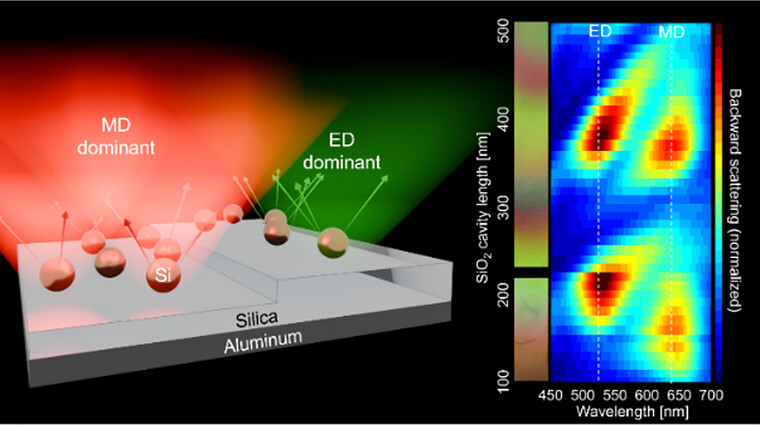
Silicon nanospheres (Si NSs) exhibit vivid structural colors originating from Mie resonances, but the coexistence of electric (ED) and magnetic (MD) dipole modes limits color saturation. Here, macroscopic color tuning of Si NS sub-monolayers is achieved by selectively exciting the ED and MD modes with a dielectric spacer and a mirror, enabling broad color tuning at a fixed NS diameter. Based on the numerical simulations, Si NS sub-monolayers with large interparticle separations are formed experimentally on a large-size substrate made from an aluminum (Al) mirror and a silica (SiO2) spacer by employing a colloidal suspension of polymer-coated Si NSs as a precursor. Independent control of the ED and MD modes by varying the spacer thickness from 100 nm to 510 nm and nearly pure MD scattering from the system are demonstrated. Wide-range color tuning is also achieved by varying the spacer thickness while keeping the Si NS size fixed. The colors remain stable for observation angles up to ∼40°, indicating non-iridescent behavior advantageous for a variety of coloration applications. Finally, bicolor printing on a substrate is performed using single-size Si NSs by patterning the spacer thickness.
-
380. Hiroki Kasai, Kento Shintani, Mojtaba Karimi Habil, Hiroaki Hasebe, Shahin Ghamari, Frank Vollmer, Hiroshi Sugimoto, Minoru Fujii, "Chirality Transfer from Chiral Molecules to Mie-Resonant Silicon Nanoparticles", Nano Letters, Vol. 26, Issue 32, pp.10802-10808(2026). (First published:August 10, 2026).
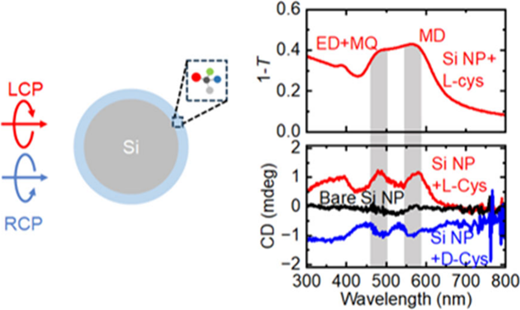
Advances in nanophotonics have enabled circular dichroism (CD) enhancement through optical chirality enhancement and chirality transfer from chiral molecules to nanoantennas. In Mie-resonant dielectric nanoantennas exhibiting both magnetic- and electric-type resonances, both mechanisms contribute to CD enhancement, and the relative contributions of chirality transfer and optical chirality density enhancement remain unclear. Here, we theoretically and experimentally investigate chirality transfer to silicon nanosphere (Si NS) nanoantennas. Analytical calculations show that a chiral shell induces differential absorption and scattering in the Si NS, producing CD signals at resonance wavelengths. Experiments using Si NSs coated with a cysteine-doped polymer layer reveal CD signals at Mie resonances, demonstrating chirality transfer from cysteine to nanoantennas. The results elucidate the underlying mechanism of chirality transfer to dielectric Mie resonators, supporting their potential applications as a platform for chiral sensing in the visible spectral region.
-
379. Zheheng Song, Oanh Vu, Jingjian Zhou, Hiroshi Sugimoto, Minoru Fujii, Lars Berglund, Ilya Sychugov, "Structural coloration for photovoltaics via sub-monolayer disordered Mie resonators", Applied Physics Letters, Vol. 128, Issue 22, pp.224102 (2026). (First published:June 4, 2026).
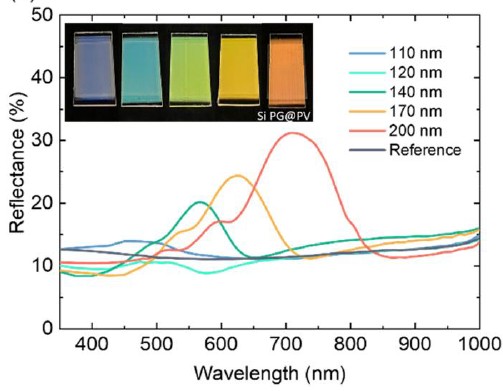
Building-integrated photovoltaics (BIPV) are currently hindered by the esthetic trade-off between power conversion efficiency and visual appeal. Conventional colorization methods generally fall into two categories: organic absorption-based dyes, which suffer from high parasitic losses and limited durability, and interference-driven multilayer thin films stacks, which exhibit undesirable iridescence. In this work, we demonstrate highly stable, largely angle-independent color PV modules utilizing a disordered sub-monolayer of dielectric silicon nanoparticles (Si NPs). By leveraging localized Mie resonances within high-index Si nanospheres (100–200 nm in diameter), the angle-dependence of the reflected color is strongly reduced. These Si NPs are encapsulated in a protective polymer shell to prevent clustering, thereby maintaining sharp scattering peaks and color saturation. The nanostructures were deposited via slot-die coating, providing a scalable fabrication route for large-area modules (∼50 cm2 PV devices demonstrated here). Numerical simulations support the experimentally observed spectrally selective reflectance driven by such Si NPs photonic glasses. We achieve a relatively broad CIE 1976 color gamut, including saturated blue, green, and yellowish hues, by varying the size and surface density of Si NPs while maintaining less than 10%–20% relative photocurrent PV loss. This offers a versatile design palette for high-efficiency, esthetically pleasing urban BIPV energy harvesting.
-
378. Keisuke Moriasa, Daiki Yabuguchi, Hiroshi Sugimoto, Minoru Fujii, "Tailoring Electric and Magnetic Dipole Emission of Er3+ Ions via Toroidal Dipole Resonance of Si Nanodisk Hexagonal Array", Advanced Optical Materials, Vol. 14, Issue 21, pp.e71295 (2026). (First published:May 14, 2026).
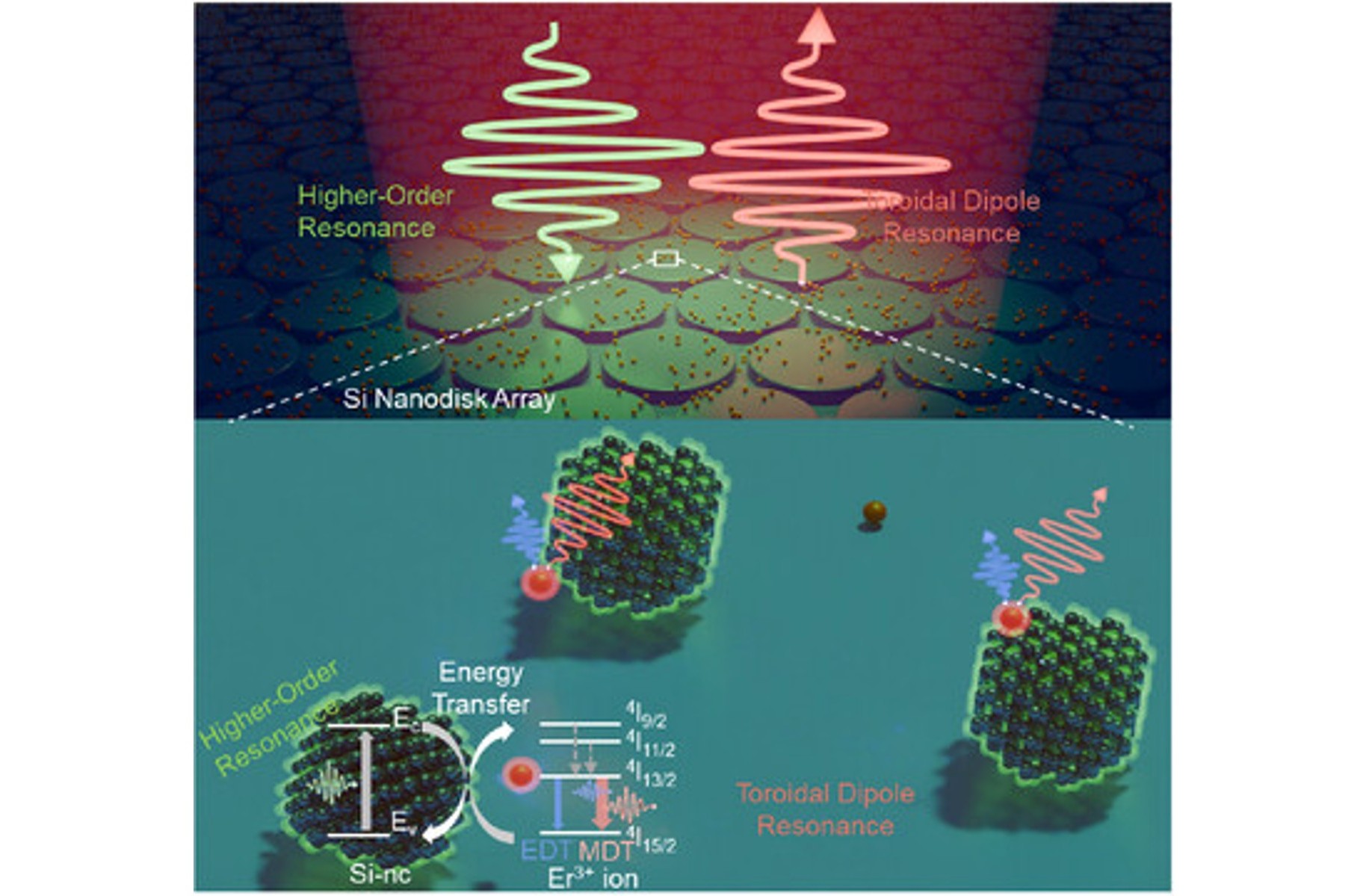
A hexagonal array of silicon (Si) nanodisks is investigated for its ability to control the 1.5-µm emission of Er3+ ions via toroidal dipole (TD) resonances. Numerical simulations reveal that the TD resonance forms accessible magnetic hot spots on the nanodisk surface, which enhances the magnetic dipole transitions of Er3+ ions and directs the emission along the surface normal through the Purcell effect. This effect is experimentally investigated in a silica film containing Er3+-doped Si nanocrystals formed on a Si nanodisk hexagonal array. The photoluminescence spectra show that the magnetic dipole transition of Er3+ ions is strongly enhanced by the TD resonance and preferentially directed in the surface-normal direction. A maximum enhancement factor of 130 is achieved under doubly resonant conditions, where both the excitation and emission wavelengths are simultaneously matched to the corresponding resonances.
-
377. Chien Quoc Nguyen, Keisuke Moriasa, Hiroshi Sugimoto, Minoru Fujii, "Narrow-Band Near-Infrared Photocurrent Enhancement via Toroidal Dipole Resonance in Si₁₋ₓGeₓ Nanodisk Array", Nanoscale Advances, Vol. 8, Issue 12, pp.3581-3586 (2026). (First published:May 8, 2026).
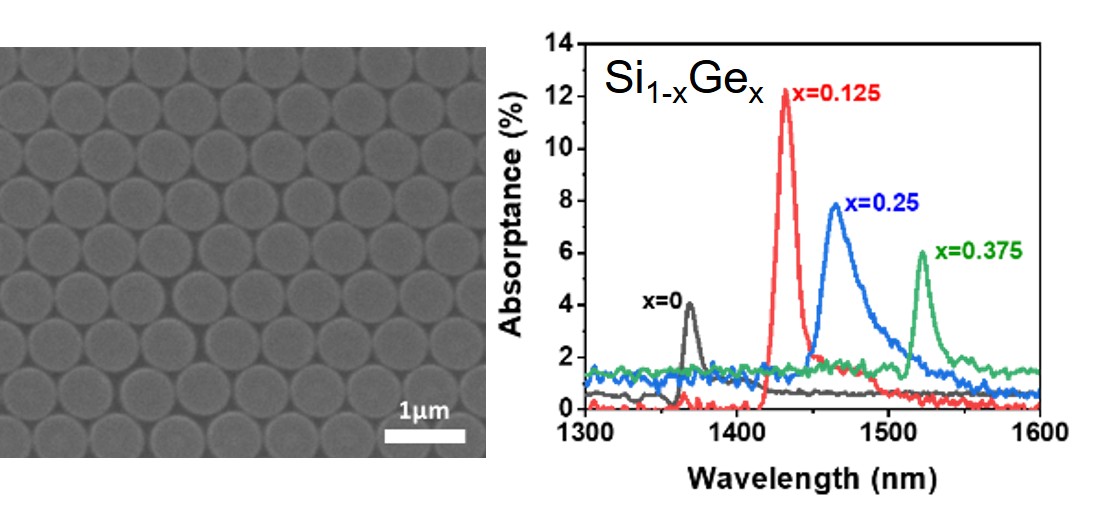
Enhancement of light absorption and photocurrent by toroidal dipole resonances in a Si nanodisk array in the near-infrared (NIR) spectral range by controlling both the structural and material parameters have been investigated. To optimize absorption, we introduced Si₁₋ₓGeₓ alloying (x < 0.375) to tune the material loss while maintaining nearly constant refractive index. Simulations revealed that absorptance does not increase monotonically with Ge content but reaches a maximum at a specific composition, corresponding to the critical coupling condition. Experimental fabrication and characterization confirmed this behavior, showing that a small Ge incorporation (x ≈ 0.125) enhances absorptance more than threefold and increases photocurrent up to 3.4 times compared with pure Si metasurfaces. This study demonstrates that alloy engineering provides a practical route to achieve critical coupling and maximize photocurrent in Si-based metasurfaces operating in the NIR region.
-
376. Hiroto Yamana, Haruki Tanaka, Hiroshi Sugimoto, Minoru Fujii, "Structural Color Inkjet Printing With Mie-Resonant Silicon Nanoparticles", Advanced Materials, Vol. 38, Issue 25, pp.e23036(2026). (First published:April 3, 2026).
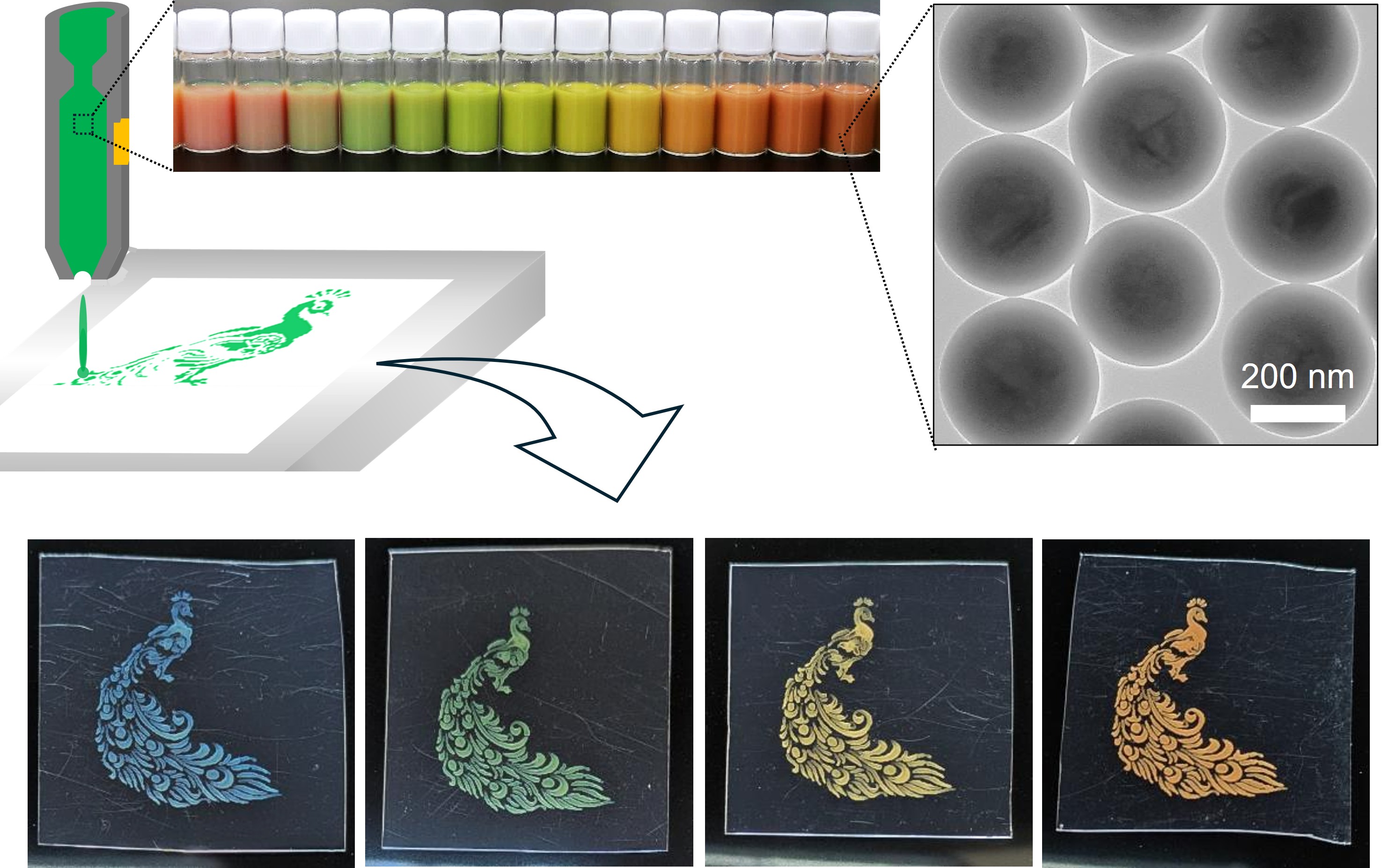
Inkjet printing of silicon nanoparticle (Si NP) inks and their inherent color asymmetry in reflection and transmission is demonstrated. The optical response of Si NP-dispersed films was initially analyzed using Monte Carlo simulations, which elucidated the physical origin of the asymmetric color appearance. Guided by these theoretical insights, water-based Si NP inks incorporating an acrylic resin were formulated and applied to inkjet printing. The printed films exhibited vivid structural colors with pronounced differences between their reflective and transmissive hues. Furthermore, multicolor patterns with tunable optical asymmetry were produced by employing Si NPs of different diameters. These results highlight the potential of Si NPs as scalable structural-color pigments for multicolor dichroic decorations in applications such as art, anti-counterfeiting, and semitransparent smart windows.
-
375. Shuto Oh, Mojtaba Karimi Habil, Hiroshi Sugimoto, Minoru Fujii, Kazunari Matsuda, Keisuke Shinokita, "Simultaneous Enhancement and Preservation of Valley-Polarized Second-Harmonic Generation in Monolayer WS2 via Mie Resonances", Nano Letters, Vol. 26, Issue 12, pp.4227-4233 (2026). (First published:March 18, 2026).
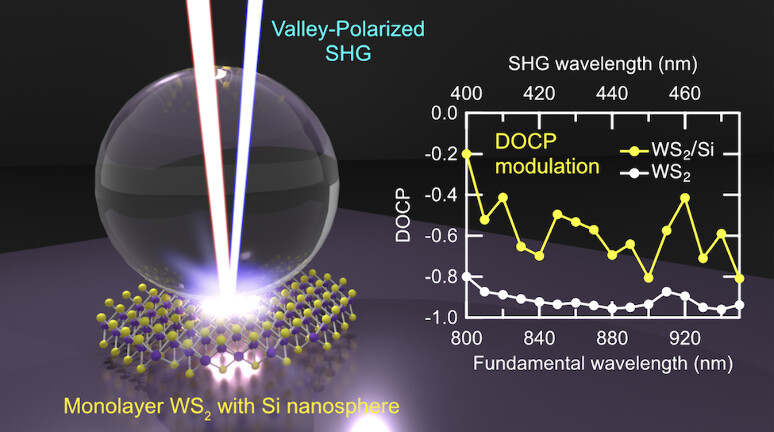
Second-harmonic generation (SHG) with rigorous polarization preservation is essential for next-generation optical information processing. Monolayer transition-metal dichalcogenides offer an attractive platform for atomically thin, on-chip light sources owing to their valley-dependent polarization selection rules for SHG. However, their atomic-scale thickness severely limits conversion efficiency. To overcome this challenge, nanophotonic structures capable of simultaneously enhancing signal intensity and maintaining high-purity polarization states are required for practical device applications. Herein, we demonstrate the simultaneous resonant enhancement and high-fidelity preservation of valley-polarized SHG in monolayer WS2 coupled with Mie-resonant silicon nanospheres. We show that the valley polarization state is spectrally modulated by the Mie modes of silicon nanospheres, achieving circular polarization retention of ∼80% within the enhanced spectral regime. These findings establish a robust strategy for manipulating polarization degrees of freedom in integrated nonlinear valley photonics.
-
374. Kana Kondo, Mojtaba Karimi Habil, Yongan Hu, Hiroshi Sugimoto, Minoru Fujii, "Thermo-Optic Tuning of Mie Resonances in Silicon Nanospheres in the Visible Range", ACS Applied Optical Materials, Vol. 4, Issue 3, pp.752-759 (2026). (First published:March 1, 2026).

The thermo-optical behavior of crystalline silicon nanospheres (Si NSs) exhibiting Mie resonances in the visible range was investigated. The temperature rise of a Si NS exhibited a nonlinear dependence on the input laser power, arising from the temperature-dependent absorption efficiency due to the thermo-optical effect on the complex refractive index. By employing this effect, active modulation of the scattering spectra was achieved through optical heating, with modulation depths reaching up to 69% at 650 nm and stable performance maintained over 50 switching cycles. The optical properties of the Si NSs remained unchanged even at temperatures of >600 °C, demonstrating their excellent thermal stability. Based on the properties, simulations were performed for Si NS square arrays, which demonstrated significant transmittance modulation by temperature-dependent shifts in the lattice resonances. These findings establish a foundation for thermally reconfigurable all-dielectric metasurfaces for their potential applications in optical modulation, sensing, and adaptive photonic systems.
-
373. Mojtaba Karimi Habil, Hiroshi Sugimoto, Daisuke Shima, Hiroto Shinomiya, Minoru Fujii, "Tailoring the Helicity-Resolved Raman Response of MoS2 Coupled to Mie-Resonant Silicon Nanospheres ", ACS Photonics, Vol. 13, Issue 6, pp.1704-1711(2026). (First published:February 23, 2026).
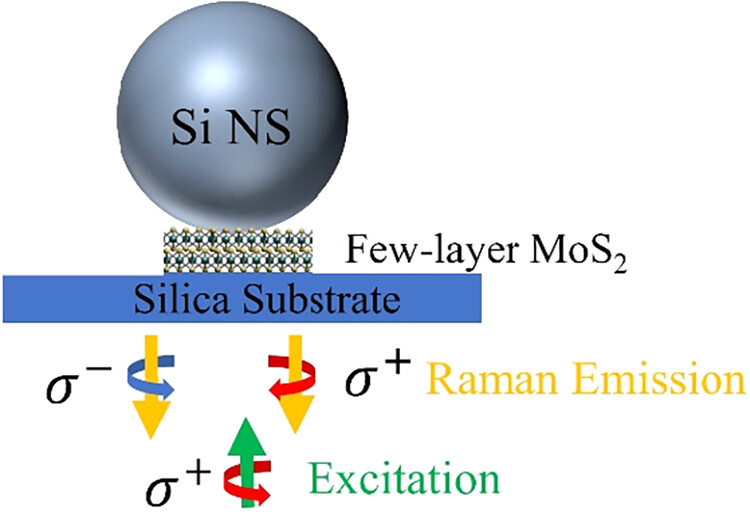
High-index all-dielectric nanoantennas supporting Mie resonances provide a versatile platform for tailoring light–matter interactions. However, their effect on the helicity of emission from nearby emitters is poorly understood. Here, we investigate the Raman intensity and degree of circular polarization (DOCP) in few-layer MoS2 coupled to the Mie resonances of silicon nanospheres (Si NSs). Theoretical analysis shows that a circularly polarized (CP) emitter near a Si NS exhibits strong radiative enhancement at the magnetic dipole (MD) and magnetic quadrupole (MQ) modes while largely preserving the ellipticity. In contrast, Au NSs provide no considerable enhancement and significantly degrade the ellipticity in their near field. Experimentally, the helicity of the out-of-plane vibration of chalcogen atoms in Si NS/MoS2 structures is well preserved at ED, MD, and MQ resonances. These results reveal Mie-mode-selective control of Raman intensity and helicity, highlighting the advantages of Si NSs for valleytronics, helicity-resolved Raman spectroscopy, and chiral nanophotonics.
-
372. María Sanz-Paz, Nicole Siegel, Guillermo Serrera, Javier González-Colsa, Fangjia Zhu, Karol Kołątaj, Minoru Fujii, Hiroshi Sugimoto, Pablo Albella, Guillermo P. Acuna, "Color Routing and Beam Steering of Single-Molecule Emission with a Spherical Silicon Nanoantenna", Advanced Functional Materials, Vol. 36, Issue 38, pp.e29955 (2026).(First published: January 26, 2026)
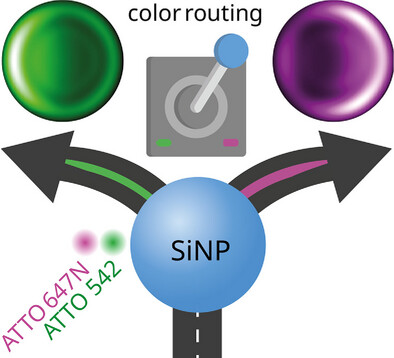
Single-photon emitters radiate as electric dipoles, which limits light collection efficiency and complicates integration into flat photonic devices. Developing nanophotonic structures capable of directing photon emission with tunable angular distributions in the visible spectrum has been pursued for applications ranging from integrated optical systems to discrimination of molecular species. To date, such directional control has been achieved using components whose overall footprint is larger than the emission wavelength and often rely on lossy plasmonic components. Here, we employ the DNA origami technique for deterministic nanoscale assembly, positioning single fluorophores in nanometric proximity to a single silicon spherical nanoparticle (SiNP) and demonstrate unidirectional emission with forward-to-backward intensity ratios up to ∼7 dB. Furthermore, we show that a single silicon nanosphere antenna can function as a color router or a beam steerer depending on its size, emitter spectral range and emitter-nanoparticle distance, enabling the use of these structures as versatile functional components in photonic devices.
-
371. Jiancheng Xu, Yuheng Mao, Yeshun Guo, Ruizhao Yao, Shulei Li, Hiroshi Sugimoto, Minoru Fujii, Fu Deng, Guangcan Li, and Sheng Lan, "Greatly enhanced photoluminescence of an integrated WSe₂ monolayer by exploiting the pure magnetic resonance and localized strain induced by a hybrid Si/Si₃N₄/Au nanoantenna",Optics Express, Vol. 34, Issue 2, pp.1369-1382 (2026).(First published: January 12, 2026)

Exploiting the optical resonances inherent to dielectric nanoparticles offers an effective approach for modulating light-matter interactions at the nanoscale while maintaining minimal optical losses. In this study, we introduce a hybrid nanoantenna platform composed of Si/Si₃N₄/Au layers, which facilitates the tuning of resonant multipolar modes and their application in enhancing the photoluminescence (PL) of WSe₂ monolayer. By systematically varying the thickness of the Si₃N₄ spacer, we achieve modulation of both the spectral positions and spatial field distributions of the resonances associated with Si nanospheres, thereby enabling precise control over near-field confinement and far-field scattering characteristics. Optimal performance is observed with an 80 nm spacer thickness, where a distinct magnetic dipole resonance emerges near 750 nm. Additionally, fine-tuning the nanoparticle radius allows for controlled red- and blue-shifting of the resonant modes. These deliberately engineered resonances lead to a substantial enhancement of the PL emission from WSe₂ integrated onto the hybrid structure, with an enhancement factor approximating 1609. The observed enhancement is attributed to a combination of intensified local electromagnetic fields and strain-induced exciton funneling, presenting a promising methodology for the active manipulation of light emission within integrated nanophotonic devices.
過去の成果は旧ページを参照してください。
Please refer to the previous website for past research achievements.